
In the realm of construction and project management, the critical juncture often lies in the discipline of cost tracking. It is at this stage that many projects either maintain their focus or spiral into chaos, leading to budget overruns and mismanaged resources. To combat this, I am providing a robust, builder-ready cost tracking structure that can be seamlessly integrated into Excel or Google Sheets. This framework is designed to be straightforward and practical, eliminating any unnecessary complexities. It emphasizes control and accountability, providing you with the tools necessary to keep your project on track and within budget, ensuring that your objectives are met without deviation.
🏗 BUILDER-READY CONSTRUCTION COST TRACKING TEMPLATE
This template has 5 Sheets:
- Master Budget Overview
- Detailed Cost Log
- Materials Tracker
- Payment Schedule & Cash Flow
- Cost per Square Foot Tracker
The Builder-Ready Construction Cost Tracking Template is an essential tool for managing construction budgets effectively. At the heart of this template is the Master Budget Overview sheet, which serves as a dashboard to assess the overall health of the build. Accompanying this is the Detailed Cost Log, where every dollar is meticulously accounted for, adhering to strict rules that require receipts for entries and immediate categorization, ensuring accurate feeding into the master totals. The Materials Tracker plays a crucial role in preventing theft, waste, and double-buying, particularly during critical phases like roofing and tile work. Finally, the Payment Schedule and Cash Flow sheet is designed to maintain financial stability throughout the project, advocating for a milestone payment structure to avoid upfront 100% payments. This proactive approach minimizes the risk of running out of funds and alleviates potential panic borrowing, ensuring a smoother construction process.
🔥 BUILDER CONTROL PRINCIPLES
When it comes to builder control principles, adhering to specific rules can significantly enhance project management and decision-making. \
Rule 1 emphasizes the importance of tracking progress on a weekly basis rather than relying on memory or irregular updates. This consistent monitoring helps identify any potential issues early on.
Rule 2 underscores the necessity of updating project details before making any new purchase decisions, ensuring that all information is current and relevant to avoid costly mistakes.
Finally, Rule 3 establishes that contingency funds are sacred and should only be accessed in instances of structural surprises, utility requirements, or safety issues, rather than for aesthetic upgrades like nicer tiles.
⚠ Where Most Builders Lose Control
Many builders often find themselves losing control during the finishing stage of a project. This is frequently due to upgrades that are introduced at this critical time, leading to disruptions and delays. Additionally, poor material quantity estimation can exacerbate these issues, causing shortages or excesses that complicate the workflow. Underestimating the complexities of site works can further derail timelines and budgets, as unforeseen challenges arise. The absence of a contingency buffer leaves little room for error, making it difficult to adapt to unexpected circumstances. Lastly, emotional decision-making can cloud judgment, leading to choices that may not be in the best interest of the project. Even if you are not an emotional type in construction. you can still drift when tired. This spreadsheet keeps you sharp.
Here is our Builder-Ready Construction Cost Tracker
Download it here:
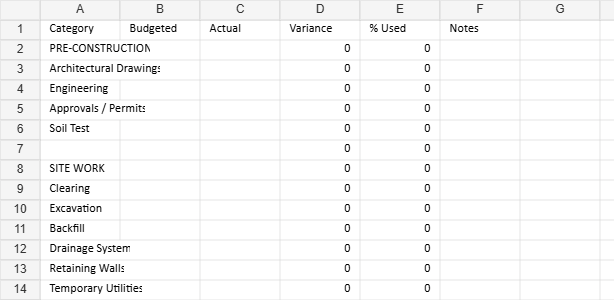
Here’s what you now have:
- Master Budget Overview – Your financial dashboard
- Detailed Cost Log – Every dollar tracked
- Materials Tracker – Prevents waste and double-buying
- Payment Schedule & Cash Flow – Keeps contractors and cash aligned
Now the important part: Open it tonight. Enter realistic budget numbers before the next construction phase begins. The spreadsheet only works if you use it weekly.